
The safest way to top up bulk Lords Mobile Gems is to verify the exact recipient account before paying, choose a payment route that leaves a clear order trail, and save proof immediately after checkout. For big purchases, most avoidable problems come from wrong-account mistakes, weak receipt evidence, repeated payment retries, or buying from offers that look cheaper than they should. If the IGG ID, payment route, or proof trail is unclear, do not proceed yet. A few minutes of checking is far easier than trying to untangle a high-value order later.
If you want the short version, it is this: confirm the recipient by IGG ID, use an official or traceable billing route, and keep a complete record of the transaction from the moment before you pay to the moment the order appears in your history. That is the core of safe Lords Mobile bulk gems top up practice.
For broader help, this topic fits naturally with a general Lords Mobile top up guide and a Lords Mobile payment and recharge help center hub, because large purchases are rarely about speed alone. They are about traceability.
What is the safest way to top up bulk Lords Mobile Gems?
For high-value purchases, the safest answer is conservative rather than clever: use an official route or a billing method with strong purchase history, verify the account with the correct IGG ID, and make sure you can prove exactly what was bought, when, and for whom.
Officially, Lords Mobile Diamonds can be purchased through the IGG Diamond Shop at lordsmobile.igg.com/diamondshop. That flow requires login with an IGG, Facebook, or Google account, and the process includes a verification code sent to the in-game mailbox. The facts available here also make one point very clear: IGG ID is the key account identifier for top-ups.
That matters because large digital purchases do not usually fail in dramatic ways. More often, they become messy because the buyer cannot later show a clean chain of evidence. In support cases involving digital top-ups, the fastest-resolved orders usually have three matching details ready at first contact: the account identifier, the payment reference, and the exact amount and time.
There is also an important distinction between what is officially documented and what players commonly report. Official guidance covers the Diamond Shop, login requirements, app store receipt history, and support channels. Community-reported patterns fill in the rest: support often asks for proof first, mismatched payer details can create friction, and suspiciously cheap gem offers are a common source of scams. Where official documentation is limited on bulk orders, it is sensible to treat those community patterns as risk signals rather than guaranteed rules.
How do I verify the correct Lords Mobile account before a big purchase?
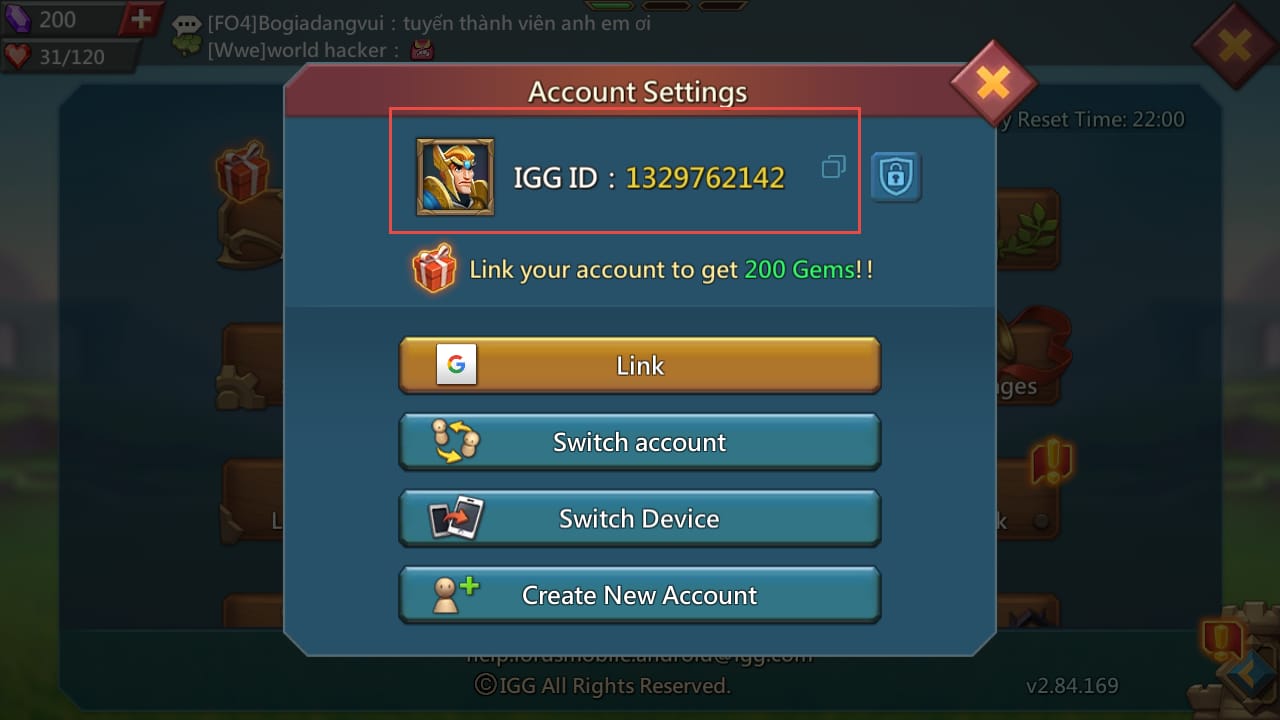
The safest habit is simple: pull the IGG ID directly from the game and treat that as the only reliable recipient identifier for a large top-up.
This is where many preventable mistakes begin. A player changes phones, switches login methods, uses a shared device, or buys for a friend and assumes the visible character is enough. It often is not. Usernames, guild context, or memory are weak checks when the purchase is expensive. The account confirmation should come from the in-game account or settings area, where the IGG ID can be seen clearly.
Before paying, save a screenshot that shows the IGG ID. If you are using the official Diamond Shop, make sure the login context matches the intended account. Officially, Diamond Shop purchases require login with an IGG, Facebook, or Google account, so a device or login change can create confusion if you are not careful about which account is active.
A few edge cases deserve extra caution:
Changed phone or changed login:
If you moved to a new device, do not assume your purchase history and account context will sort themselves out later. The available facts indicate that purchase restore and order lookup depend on the same app store account being used, and official guidance points users to App Store purchase history or Google Play orders when checking prior purchases.
Shared device:
Community reports consistently treat shared-device top-ups as higher risk for wrong-recipient mistakes and later chargeback disputes. If you top up on a shared phone or tablet, reconfirm the IGG ID before payment and log out after the transaction. That extra step is not glamorous, but it reduces confusion if another person uses the device later.
Buying for someone else:
If this is a gift or a favor, the recipient should send you the IGG ID directly. Screenshot that confirmation and keep it with the rest of your proof. That way, if there is a dispute about the intended recipient, you have a record showing what was provided to you before checkout.
If you are worried about a Lords Mobile wrong account top up, the best protection is not recovery after the fact. It is refusing to proceed until the IGG ID is confirmed from the source.
Which payment route gives the clearest proof later?
For large purchases, the best payment route is usually the one that leaves the clearest evidence trail, not the one that feels fastest in the moment.
The strongest officially supported proof path tends to come from Apple App Store and Google Play billing because both provide purchase history. The facts here confirm that app store billing is traceable through purchase history, that Apple receipts can be retrieved from email or history, and that the Google Play order number is key proof for Android disputes. If you later need to show that a purchase happened, those records are often easier to retrieve than a vague bank notification.
The official IGG Diamond Shop is also a valid route, especially because it is part of the official Lords Mobile purchase flow and uses account login plus in-game verification code delivery. Community experience further suggests that card payments through the official Diamond Shop are generally safer for support than less formal channels because there is an order history and a direct relationship to official support.
What should be avoided is any route that weakens traceability. The facts explicitly state there is no official crypto, USDT, or Binance Pay route. For a high-value order, that matters. If a payment method leaves poor documentation or sits outside the official support framework, it becomes much harder to prove what happened if the order is delayed or disputed.
A practical way to think about the options is this:
App Store / Google Play: strongest built-in purchase history
Official IGG web checkout: good traceability when account and payment details match
Card or wallet through official channels: workable if the order record is clear
Voucher-style routes: can be harder to document cleanly, and region mismatch may matter
Unofficial or stranger-sold offers: poor proof, high scam risk
This is also where the difference between official guidance and community consensus matters. Officially, app store receipts and official IGG channels are documented. Community consensus goes further and says official or app store routes are generally better than third-party options when reimbursement proof or dispute handling becomes necessary. That is not a formal guarantee, but it is a sensible risk interpretation.
If you are comparing routes in more detail, this topic overlaps with a Lords Mobile web checkout vs app store billing discussion. For expensive purchases, traceability should carry more weight than convenience.
What receipt proof should you save before and after checkout?
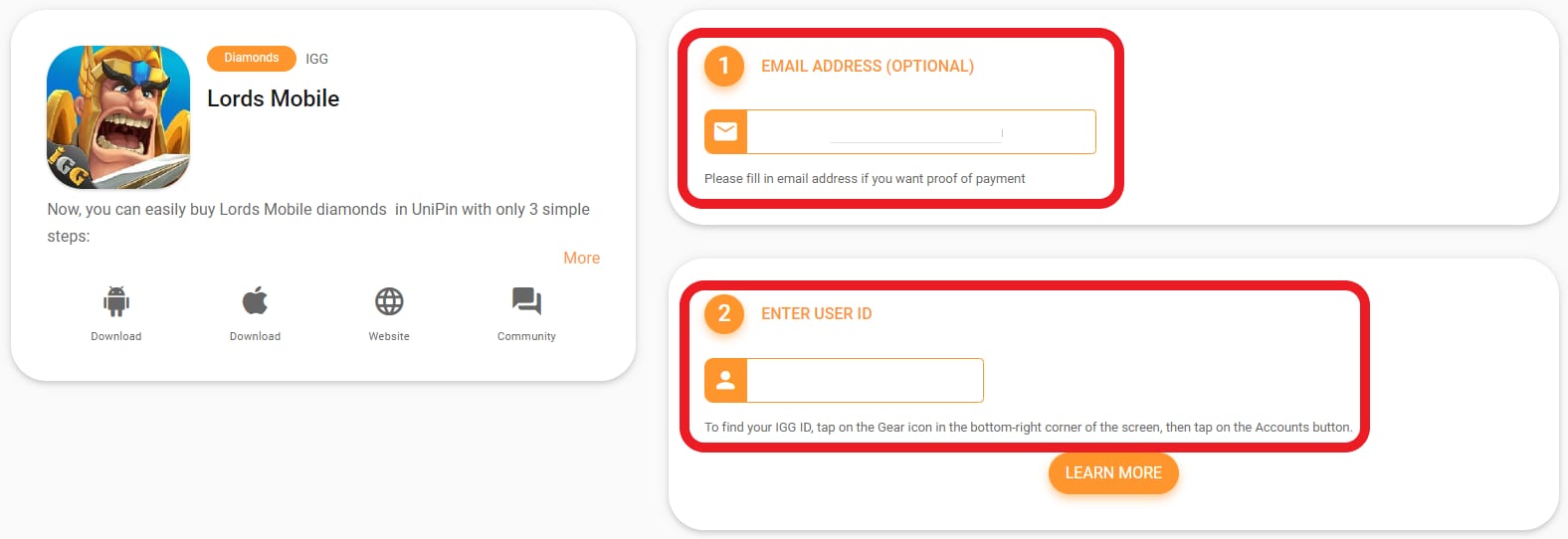
The most useful proof is not a random pile of screenshots. It is a small, complete evidence bundle that ties the account, payment, and order together.
A practical minimum set, drawn from the facts and community support patterns, looks like this:
Before payment, save:
the IGG ID screenshot
the intended pack name
the amount
After payment, save:
the order ID
the transaction ID
the receipt email, invoice, or receipt page
the timestamp
the amount paid
a screenshot of the success page or order history
This is the kind of proof that support can actually use. By contrast, some screenshots feel useful in the moment but often do not help much on their own: a bank SMS with no merchant reference, a cropped payment image with the amount hidden, or a screenshot showing missing gems but no order number attached.
It also helps to keep the evidence organized. If the order is large, do not leave everything scattered across notifications, email, and your photo gallery. Put the screenshots and receipt in one folder and label them clearly enough that you can find them quickly. When support asks for proof, speed matters less than completeness, but both are easier when your records are tidy.
This is especially important if you later need a Lords Mobile invoice receipt, Lords Mobile payment proof, or a support-ready bundle for a delayed order. In practice, the first response from support often goes more smoothly when the buyer can immediately provide the IGG ID, order reference, and exact purchase details without backtracking.
Why would a bulk Lords Mobile payment be flagged for review?
Large digital purchases are more likely to be reviewed when something about the transaction looks unusual, inconsistent, or difficult to verify.
Some of these triggers are community-reported rather than formally documented by IGG, so they should be read as patterns, not official policy. Still, the patterns are consistent enough to be useful. Common risk triggers include:
payer details that do not match the account context
an unusually large order size
repeated retries after a failed payment
a new account making a very large early purchase
suspiciously discounted offers from strangers
shared-device confusion that later resembles a chargeback dispute
The facts database does not state a formal bulk top-up limit. It does, however, note that unusual sizes may require manual support verification. That is an important nuance. No stated limit does not mean no review risk.
This is also where buyers often ask whether one large purchase is safer than several smaller ones. There is no official universal rule in the facts, but there is a useful trade-off. A single large order can create a cleaner proof trail because there is one order, one timestamp, and one receipt set. On the other hand, a very large amount may look unusual and trigger review. Split orders may reduce the size of each individual transaction, but they can also create a messier support trail and, if done through repeated retries, may look more suspicious rather than less.
So the better framing is not big vs small in the abstract. It is clear and deliberate vs messy and reactive. If your payment method has strict limits, splitting may be necessary. But if your first attempt fails, repeatedly hammering the payment button is one of the worst ways to proceed. That can create duplicate records, confusion over what actually settled, and extra fraud checks.
Another hard warning belongs here: community reports strongly advise avoiding gem dealers and unofficial bulk sellers. Suspiciously cheap offers are not just a pricing issue. They are a proof issue. If the route itself is hard to verify, support becomes harder before the transaction even starts.
What should you do if payment succeeds but the gems do not arrive?
Start by separating a short delay from a true delivery problem, then escalate with a complete proof bundle.
Officially, if gems are missing after a Google Play purchase, users are advised to check connectivity, force stop the app, and then contact support with proof. More broadly, the practical response path for a high-value order is straightforward.
First, confirm that the payment actually completed rather than sitting as a pending authorization. Then check the game mailbox for any verification-related message, especially if you used the official Diamond Shop flow, since the official process includes a verification code sent to the in-game mailbox. After that, re-check the IGG ID tied to the intended purchase and gather your evidence: IGG ID, order ID, transaction ID, receipt, amount, timestamp, and screenshots.
For formal escalation, the official support route is the IGG support ticket system at cs-ticket.igg.com. The facts also list platform-specific support emails:
Android:
help.lordsmobile.android@igg.comiOS:
ihelp.lordsmobile@igg.com
Community-reported experience suggests that for delayed or missing gems, support usually asks for proof first. That aligns with the broader pattern seen in digital top-up cases: the more complete your first message is, the less time is lost in back-and-forth.
A clean support message should include the account identifier, purchase date and time, pack or gem amount, order ID or transaction ID, payment method, and a short statement that payment succeeded but the gems were delayed or missing. Attach the receipt and screenshots in the same submission. One complete ticket is usually better than several fragmented ones.
If you need more detailed help on this specific problem, it naturally connects to a Lords Mobile gems not received after payment guide and a How to get a Lords Mobile receipt or invoice article, because those two issues often overlap.
Before you place the order, make the decision boring
For expensive packs, the best practice is not to chase the most exciting route. It is to make the purchase as easy to verify as possible.
That means using the official Lords Mobile website or official Diamond Shop where appropriate, or app store billing when you want strong purchase-history records. It means confirming the IGG ID directly in-game before paying. It means saving proof before and after checkout. And it means stopping immediately if something feels off: the account context changed, the payer details do not line up, the offer looks suspiciously discounted, or the first payment attempt failed and you are tempted to retry repeatedly.
If you are topping up from a shared device or for another person, be even more conservative. Those are the situations where wrong-recipient mistakes and chargeback risk become harder to untangle later. A screenshot of the recipient’s IGG ID, a clean receipt trail, and a logged-out device after purchase are small steps that can prevent much larger problems.
The final recommendation is simple. For a Lords Mobile safe top up, proceed only after three things are locked in: the exact recipient account, the payment route, and the proof trail. If any one of those is uncertain, the safest move is to pause. In high-value digital purchases, caution is not overkill. It is the whole strategy.
👉 Lords Mobile bulk gems top up 👈
✅ Safe and convenient digital top-up service
✅ Orders are processed promptly after successful payment
✅ Supports popular products and recharge scenarios
✅ Customer support can help with order issues